Home Decor

Lifestyle & Fashion

Classroom Blog

Showing posts with label math games. Show all posts

What's In My Math Tutoring Tub?


School may be out for summer but for many of us, the work might not come to a complete end! How many of you all tutor? I love tutoring over the summer because not only is it a great way to see student progress, it keeps my teacher brain on it's toes! Each summer I put together "tutor tubs." I make sure to create a balance between games, manipulatives and worksheets. Most importantly, I make it specific to each student's needs. I thought I'd share some tips with you on how to assemble an engaging and fun math tutor tub!

This post contains affiliate links for your shopping convenience. 

The "tutoring tub" is meant for you to be able to pull materials when doing a tutoring session, but also for your student to pull from to review on the days you may not be there. This is such a great way to establish consistency results! 


MATH GAMES AND PRINTABLES

The easiest way to engage your students is using fun math games and printables. If you're anything like me, you have more than enough resources you use in the classroom to choose from. However, it's important to choose wisely! I find myself choosing those that are aligned to the CCSS and incorporate the use of math tools and manipulatives.

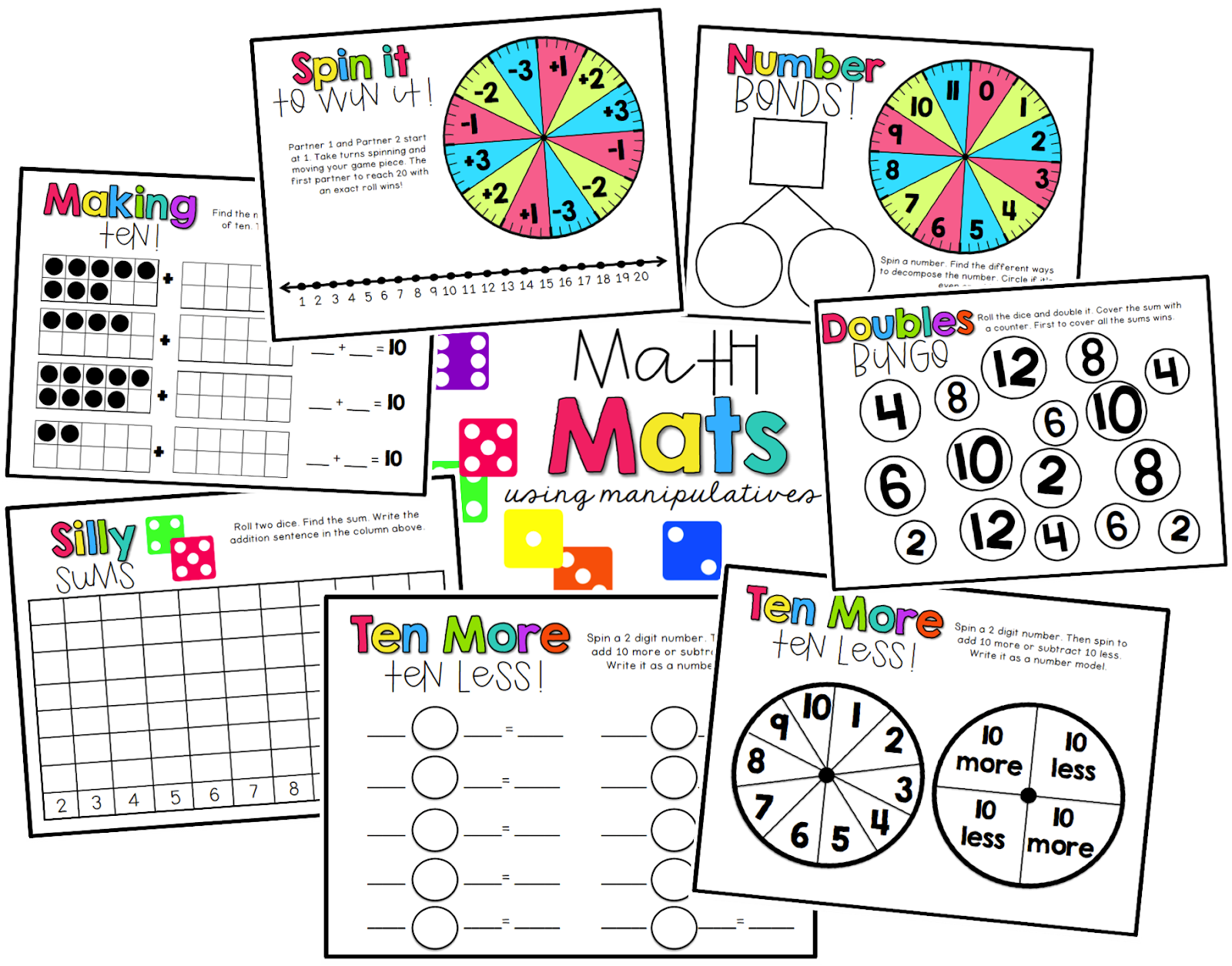
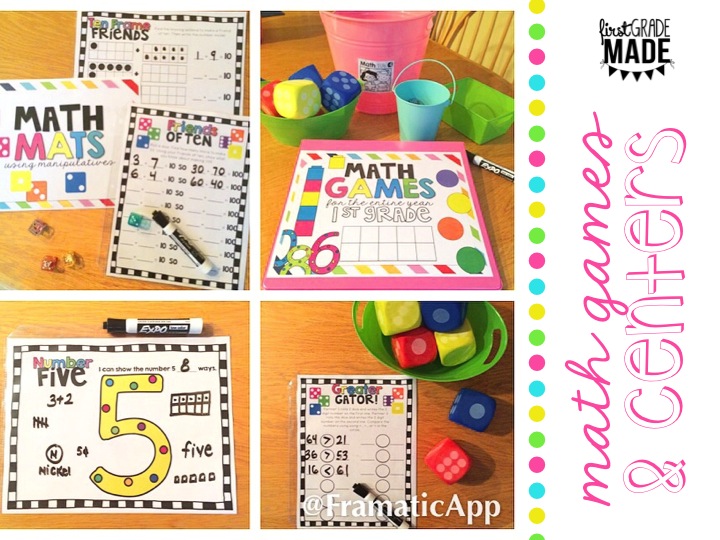
If you're in the market, I've included a preview of my First Grade CCSS aligned math games and centers. These have many skills embedded in a game format. It also features an accountability piece, as well as the use of math manipulatives. It includes 20 different resources without breaking the bank!

You can find them in my TPT shop here. 


When assembling them, I choose the skills that fit the needs of the student. Then, I place them in sheet protectors and put them in a binder. This is the perfect way to keep them in one place and ensure they are durable for many uses. Looking for sheet protectors? You can find them here. 

If you're on an ink saving budget, consider printing everything on different bright colored paper. This gives just about any activity a fresh facelift! In the market for a great colored paper buy? Check out this multicolored Astrobrights pack here.  


MATH TOOLS AND MODELS

In addition to games and centers, bringing math to life is so important! Incorporating the use of math tools and models will help develop their mathematical practices. This is definitely my favorite part of my tutoring tubs! I could probably blog for a full 24 hours straight about all of the math tools and models I use in my classroom.  I've compiled a few that are super important and that you may be able to benefit from. 


First of all, Reagan Tunstall is an absolute genius! She is rocking out living her best life doing my absolute dream- creating her own math curriculum. She is super talented and I was thrilled when I stumbled upon her printable math tools- here!

I printed these out on colored Astrobrights cardstock and laminated them for extra durability. The Scotch 3m Laminating Pouches are great with little hands and constant use! 


Being that so many games and printables include the use of dice, I am sure to include an assortment!

Foam dice, double dice and tens frame dice are my favorite. If you're interested in getting a set for yourself, click on the product name or image above!


These may be old school but rekenreks (math racks) and addition and subtraction flashcards are still very effective. I spent the past two years researching and developing my own ideas about math facts and these flashcards give me all the feels! Love the way they create a context for numbers. 

The list goes on and on, but I feel confident I've shared some math tutoring tub tips and tricks! I hope this makes your prep time and transition into tutoring this summer much smoother. 

What tools do you use? Comment below! 

4

Math Tools and Models to Support Numeracy and Math Literacy


How many of you have gotten this response when your math curriculum asks your students, "Solve this problem and show me your thinking."? If you're raising your hand and laughing... you're not alone! Even I have gotten my fair share of those answers and as cute as they are- because my word they are too cute and one of the many reasons I love the primary grades :) - what are we going to do about it?

When conferring with students in math workshop, one of my favorite questions when they are working is "pick your tool or model show me how you're using it." This requires students to use a conceptual understanding of the math skill in order for them to demonstrate whether they know how to use the tool or model. This is ultimately the mathematical literacy we are all now striving to achieve in our classrooms. It also encompass many of the CCSS Standards for Mathematical practice. 

I'm not sure about you but I am always looking for a way to spice up my math workshop games and centers! Math tools and manpulatives are an easy and effective way to support engagement and mathematical literacy. Math is a subject that is so important to foster a positive growth mindset at an early age. Over the years I've collected some fun and engaging tools that support my math instruction that I'm excited to share with you!!

Before I do, there is something I would like to share with you that I learned after recently attending a Mathematics in the City summer institute in NYC. The presenter brought to my attention something that has completely transformed the way I think about math manipulatives. Ultimately, there is a difference between math tools and math models.  A math tool is a physical object that a student can manipulate to help them solve a problem. I like to think of this as your typical math manipulative. For example, dice, calculators, pattern blocks, base ten blocks, money, etc. 

Here are some of my favorite math tools and where you will be able to purchase them!


One of my personal and kid favorites are my jumbo double dice from Lakeshore! They are a great way to differentiate your centers. I have purchased a few sets of double dice before and this is my favorite because both sets of dice are large enough for not only our tiny finger in primary land but also so that both sets of dice are large enough to see. :) You can find them here. 


 A calendar favorite is definitely our magnetic tens frames to build the calendar date each month. We also use the green and blue dots to make various partterns each month throughout the year. It is the perfect way to build fluency with composing numbers through 30-31. These particular colors are discontinued however, they still have them in red and blue. You can find them here.

We also have magnetic money and base ten blocks. Each day we add one penny and one "one." Their magnetic ability makes it easy to manipulate on the board during our discussions when we may need to regroup or make a different combination of coins. Plus lets be honest, anything magnetic is more fun!  You can find them here.
I also keep quite the collection of Target Dollar spot erasers so that they can be changed from season to season. At the start of the year, they may simply be used as counters to represent numbers. Then we transition to becoming fluent composing and decomposing numbers 0-20 and eventually we link this to addition with two or more addends. Tens frames and counters also make a great visual for subtraction.  


 Two math manipulatives that are always such a hit are magnetic numbers and magnetic dominoes! They grew to become so popular that they turned into indoor recess games rather than just "math centers." :) The magnetic numbers can be used at the beginning of the year to order and compare numbers when counting. Eventually we used them to make up our own addition problems to solve on the white board. This is a great center than can be easily differentiated based on the numbers given to the students or the number of digits to add (ed. double and/or triple digit addition). Its important to teach into the concept that these are a TOOL not a TOY. Ha! I won't be shy in admitting that we usually need this reminder more than a *few* times. :)  They can be purchased here.

The magnetic dominoes are my newest addition and I'm still coming up with some effective ways to use them in my classroom. If you come up with any ideas, don't hesitate to comment below! As of now we use them to compare numbers, part-part- whole addition problems as well as to build fact families! You can find these on Scholastic Reading Club and purchase them with your teaching points. :) 


Unifix cubes are a great tool for one-to-one correspondence as well as a visual aid for addition!


Foam dice in an assortment of sizes are a teacher favorite because of how quietly they roll. Ha! These pictured here can be found at Five Below. I have also purchased smaller versions at the Dollar Tree. I am currently on the hunt for dice with dry erase sides... wish me luck!


 These number cards here are a part of our tool kit from Everyday Mathematics. They are a great tool for subitizing. I have also purchased tens frames cards from Lakeshore that can be seen here. It is also easy to print pictures of tens frames on card stock, cut and make your own cards if you are looking to be savvy with your money. :)
Jenga and cup stacking is not necessarily a math tool but a great way to practice math facts.  If you are looking to see how I use these games below in math centers, please read my previous post here! 

I love providing students with ample opportunities to practice using manipulatives in an engaging way. While there may be times where students interact with manipulatives without a worksheet, I believe sometimes it is important to have an accountability piece. I have created a Math Games Bundle aligned to the CCSS for first grade that allows students to practice math skills with manipulatives. These are the perfect centers to use all year long! They can be found in my TPT store here. 


Now that you are up to date on math tools, lets transition to math models. A math model on the other hand shows structure. It demonstrates student thinking in an organized way. For example, tens frames model numbers and have a structure of ten. Math racks or rekenreks are another great math model that can be purchases with different structures based on what grade level you teach (structures of 5, 10 and 20). Number bonds and part-part whole models various number compositions. Tallies, dots, number lines and hundreds grids model number space. They are focused on the distance between numbers- which is less and which is more.   

I have created math maths to be used as reusable math models to build math literacy in the classroom. I plan to print them on card stock, laminate them and place them in pocket protectors. When I teach a specific skill, I will teach into each model as a strategy to solve and model one's thinking. Then I will add them to our math center in a place where students can access them whenever they need during math workshop. 

                      
This is the perfect mat for students to organize their base ten blocks when adding two digit numbers. It will allow them to organize and visualize the different places and their values.


Tens frames are perfect for subitizing, number recognition, combinations of ten, decomposing numbers, adding two or three addends, modeling subtraction and of course modeling numbers and their value.

Open number lines are perfect for modeling adding and subtracting single and two digit numbers, comparing numbers, skip counting and finding the distance between numbers.

Number bonds are perfect for number composition which eventually leads to addition and subtraction. They can be filled with numbers or manipulatives in order to help with one-to-one correspondence, hierarchical inclusion of a number (aka 1 and 2 fits inside 3- think of the Russian dolls :) ). This is a great tool for numeracy and that numbers have values when connected to real objets or measures


You can find these in color and black and white in my TPT store HERE. 

When teaching math in the primary grades, it's important that we must remember the math is not in the tool or the model. Therefore, we can not just give students a tool or model and expect they know how to use it. We must provide opportunities for students to mathematize the tools and models. This is just a big fancy word for teach into the math. Then you must provide opportunities for them to contextualize it. In other words- When is it appropraite to use this model? In what context? 

In order to do this, I spend time in the beginning of the year exploring the tools by asking questions, "what do you notice?" or "What do you see?" Then once students are using them to solve problems, I move to asking, "Did anyone do/see anything different? or "How could that help you?" I also create anchor charts for the different tools/model we can use to solve addition and subtraction problems. Eventually these questions and strategies will lead your students to be able to respond to the "show me your thinking."  


0

Making Math FUN!


It is true... there is a special place in my heart for teaching math. Although many see math as black and white, I enjoy finding those areas of gray. :) Like why is 0 the most important number? And why is -8 smaller than 0? Any why can the solution to a problem be infinity? And WHAT is infinity? Get the picture? :) What makes teaching math successful in my classroom is sharing my intrigue for math with my students. I'm not afraid to bring up negative numbers or the idea of infinity with 6 and 7 years olds because it exposes them to how much there is to learn and how exciting it feels to learn something new. This type of math conversation, one that can be out of their comfort zone, sparks meaningful discussions and questioning and shows the true progression of skills/concepts in math. Then I tell my students they are learning "high school" math which not only cues their listening ears, but gives them bragging rights to the other first grade teachers! HA! ;)

As you may know, I am a HUGE fan of the math workshop model. I think the key to making math fun is to keep it student centered and interactive. With that being said, we need to have the students doing more of the "doing" and the "talking." The workshop model supports that type of environment. Each day we begin math by piggy backing off of the math we do in calendar, which I find works magic for a smooth transition. We have ourselves in a "math mind" and ready to use our "math mouth." I lead our whole group mini-lesson for about 15 minutes, introducing the new vocabulary and skill. Keeping it short and simple makes it really clear of our kiddos what we will be learning by the end of the lesson. Then we branch out into 3 groups (which are made at the start of the unit based on pre-assessment scores). 

My enrichment students work independently on an enrichment activity and then partner/group up to do a think-pair-share amongst themselves. I check in with them during this at the end of the workshop and come prepared with questions to stretch their thinking. This usually leads us to a mini-lesson that stretches the skill to their level. I meet with my low group first each day. I do a reteach of the lesson I teach using all manipulatives as support. Then I get them started on an worksheet/activity that we do together as a small group. Even though we do it "together," I ask questions individually to gage and check for individual understanding. If students are grasping it quickly, I send them to work in the middle group. This allows me to give as much attention as possible to the kiddos who need it. After we are done meeting as a group, I allow them to choose a math tub of their choice to complete. Then I go check in with my middle group. My middle group works with a partner on an assigned activity in my tubs. This can include anything from a worksheet, a math journal writing page, one of the many fabulous centers from TpT or my personal favorite... a math game!  

Math games are a KEY component to engaging students in math. Math is not just a worksheet people! I am excited to share with you some of my personal favorites that are easy and free (assuming you have some of the classic materials already laying around :))!! 

My personal favorite games to practice math facts are Jenga and fast fact stacking. I printed addition facts on Avery labels and placed them in the inside of the pieces so that when stacking them, the kiddos don't know the problem until they pull the piece out. :) I also placed the remaining labels on plastic cups. These can be used for fast fact stacking. Fast fact stacking is when students have a certain number of cups (10ish to start and increase over the year) and they have to see home many facts they can get right in 2 minutes (timer from the Dollar Tree). Students will have a teammate to work with. They start with the cups in a stack. One by one they pull a cup from the top of the stack, look at the problem and say the answer. The teammate is responsible for checking their answer. If they get it wrong, they can't stack that cup in their tower. They must discard it. Then the partner switch turns. 

Another great skill that you can use just about any manipulative you have is a subitizing center. It may be more of a Kindergarten skill/standard but I believe it is such an important fundational skill that helps develop a stronger conceptual understanding of addition, place value and much more! 


You can pick up your own copy of the addition facts to be printed on Avery labels 5160 here.


Another great fact practice center is Dunk-it! Dominoes. Place cups with numbers to act as sums around the center. Students can choose dominoes from a pile, add the two addends and place it in a cup with it's corresponding sum. This can also be used from doubles. Students can also use dominoes to add the addends and double it! 
Anyone else a big fan of war?! I LOVED playing it as a kid and now it is so fun seeing a classic stay alive in my classroom. This game can be used to compare numbers. It can also be easily differentiated by having students who are ready take two cards and add it for the sum. It can also be used to practice doubles! 
 Another thing to consider is making a math game accountable. I think it's also important to remember the benefit of including a recording sheet with some math games. Below are some games that I use in my classroom all year that include recording sheets from my Math Games and Centers Bundle on TpT. I print them and place them in sheet protectors. My students and I love how they are interactive and engaging! They guide students towards using manipulatives. I usually leave a few of these out in math tubs at a time and allow students to choose.  The students even ask to bring them out a recess!! ;)


As I mentioned before, the key to making math fun is to put the learning in the hands of our students.  As important as it is to give them independence, I feel there is value in coming back as a whole group and "reflecting" on their learning for that day. After our workshop, we come back to the carpet for about 4-5 minutes to share out anything "new" they learned, any questions they had, and "ah ha! moments." I encourage them to share out using accountable talk stems, which encourages them to use their classmates names and math vocabulary. Then we give ourselves a 5 star rating for if they were able to reach our learning target for the day. This is usually my favorite part because they get so excited knowing they were responsible for their learning that day.  :) 

2

Search This Blog